Mining for Efficiency
Mining sits at a difficult intersection right now. On one hand, it is indispensable to the global technology revolution: the batteries, chips and cables powering the energy transition all start here, and yet the sector itself has been slow to apply that same spirit of progress to its own operations. The materials that build a cleaner world are still too often extracted in ways that contradict it.
The economic weight of Australian mining
The numbers are hard to ignore: mining and resources contributed approximately $385 billion to Australia's export earnings in 2024-25, according to the June 2025 Resources and Energy Quarterly published by the Department of Industry, Science and Resources. The sector directly employs more than 300,000 Australians, with hundreds of thousands more supported through supply chains and associated industries. From iron ore in the Pilbara to lithium in Western Australia and coal in Queensland, the resources sector is not a peripheral part of the Australian economy. It is one of its most powerful engines.
That scale also reframes the sustainability conversation. Australia's mining majors are among the most profitable companies on the ASX, posting billions in earnings in the past year, illustrating the industry has both the financial capacity and the platform to lead on decarbonisation in a way few other sectors can match. The question is not whether they can afford to act, rather it is how they might choose to use that position.
How can mine sites become more sustainable?
Under the globally recognised accountability framework, Towards Sustainable Mining (TSM), mining companies are required to continually evaluate, manage and communicate site performance against sustainability objectives.
Like many heavy industries, mining faces significant challenges in adopting more sustainable measures to significantly reduce its environmental impact, however much like the transport sector, there are avenues to consider:
- Utilise renewables: Mine sites can replace legacy diesel and coal power with solar, wind and battery storage technologies to power electrified trucks, excavators and processing plants to reduce emissions.
- Manage water responsibly: Reduce usage of local water supplies and instead deploy closed-loop water circuits, recycling systems and desalination to use and re-use water reserves.
- Repurpose tailings and waste: Treat mine waste as a resource by extracting residual metals from tailings, re-employ waste rock for construction or use dry-stack tailings to bolster dam structures.
- Ongoing land rehabilitation: Rather than waiting for a mine site to close, operators can pro-actively reshape the topography, replace topsoil and reintroduce native plants during a mine site’s lifecycle to encourage more biodiversity and prevent soil erosion after decommissioning.
- Repurpose closed mine sites: Many mine sites are suitable to be recommissioned after they close, for potential uses such as community hubs, agriculture and recreation.
Harnessing technology
Technology is the most practical lever the sector has for closing the gap between where it is and where it needs to be. The conversation often starts with electric trucks and machinery (visible, tangible, easy to point to), but they represent only one part of a much larger shift happening across mine sites.
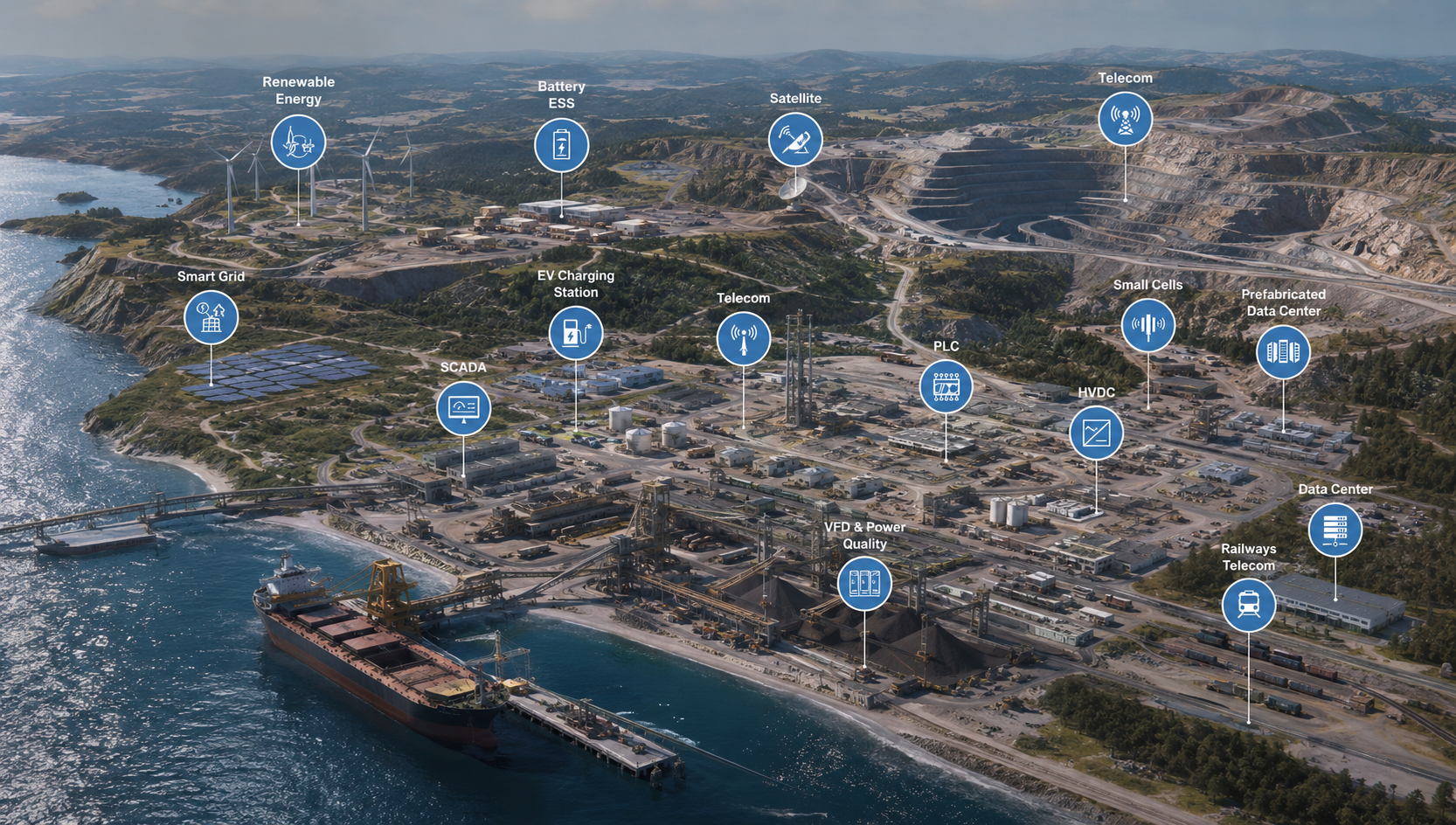
A ‘Pit to Port’ solution, like the one offered by Delta, implements sustainability measures on mine sites holistically by employing a raft of interconnected smart technologies to maximise site efficiency and reduce emissions and wastage. Examples within the ecosystem include:
- Smart grid systems and microgrids for smooth, reliable power supply
- Hydrogen fuel cell and renewable energy storage
- Heavyduty industrial telecommunications to maintain continuous connection between the mine pit, truck and machinery and trains
- Electric vehicle charging stations and energy efficient automation to electrify mine fleets
In some ways, a smart mine site is its own circular economy. Many of the raw materials extracted from sites return to it in the form of componentry used in the smart technologies that help the site perform at its best.
It’s already happening: proof that it’s possible
The counterargument to industry inaction exists within the industry itself. Fortescue has committed to real zero operational emissions by 2030, targeting full elimination of Scope 1 and 2 emissions. Meanwhile, trials of autonomous and battery-electric equipment at Prominent Hill in South Australia have shown that underground operations can cut both emissions and safety risk at the same time. These examples matter because they remove the excuse that it cannot be done.
Managing change
Mining has never operated in a stable environment, and no one in the industry expects it to. Commodity prices shift, geopolitics intervene, supply chains fracture. The operators who manage best are those who have built enough visibility into their operations to respond quickly, rather than reactively.
That visibility comes from connected technology. IoT-enabled devices, AI-driven software and integrated site communications give operators real-time insight across the full operation, from pit to port, so decisions are based on data rather than assumption. In volatile conditions, that kind of operational intelligence is not a nice-to-have. It is how well-run sites stay ahead.
The future of mining
The relationship between AI and mining runs in two directions, and it’s worth being clear about both. On one side, AI and automation are already reshaping how mines operate, improving predictive maintenance, optimising haulage routes, reducing energy waste and enabling remote monitoring of equipment that would otherwise require people in hazardous environments. On the other, the AI revolution is driving unprecedented demand for the materials mining produces: copper for data centre cooling and power infrastructure, lithium and cobalt for batteries, rare earths for processors. Mining is not peripheral to the technology economy. It is the foundation of it, and that dependence is only deepening.
No doubt mining is facing a double-edged sword of sorts. Decarbonising a mining operation involves real costs, real trade-offs, and real engineering challenges. But the companies that will define the next decade of Australian resources are not the ones waiting for the regulatory environment to force their hand. Instead, they are driving the industry forward in real-time by utilising emergiing technology and sustainable practises to extract further value from mine sites than previously thought possible.
Further reading:
Australia is Moving Towards Sustainable Mining
Minerals Council of Australia
https://tsmining.com.au
Info Page: Mining in Australia
Delta Electronics Australia
https://www.deltaelectronics.com.au/en-AU/landing/Mining-In-Australia
Resources and Energy Quarterly: June 2025
Department of Industry, Science and Resources
https://www.industry.gov.au/news/australias-resources-and-energy-exports-set-soften-amid-trade-uncertainties
Mining Industry Employment Profile
Jobs and Skills Australia (sourced from ABS Labour Force Survey)
https://www.jobsandskills.gov.au/data/occupation-and-industry-profiles/industries/mining
Australia’s 2030 Emissions Reduction Target
Department of Climate Change, Energy, the Environment and Water
https://www.dcceew.gov.au/climate-change/emissions-reduction
Climate Action: Fortescue Real Zero
Fortescue Ltd
https://www.fortescue.com/sustainability/climate-action